
Going the Last Mile Where Others Can’t
In the field of unmanned aerial system (UAS) operations, an incident or a loss of signal in complex terrain presents a double setback. On one hand, there is the financial impact of losing the airframe and payload; on the other—and often far more critical—is the invaluable asset stored on the local memory media: gigabytes of point clouds, photogrammetric surveys, industrial thermal captures, or irreplaceable cinematic footage.
When an aircraft goes down on a vertical cliff face, under a dense forest canopy, or within high-mountain terrain with hostile topography, the default reaction is often to write off the asset. At GOAT Drones, however, we approach field operations with a firm principle: the mission isn’t over as long as a viable access path exists. In addition, leaving a UAS in the field with its battery poses a significant risk of pollution and forest fires.
Complex Terrain Operations and Technical Access Capabilities
Recovering equipment in rugged environments requires far more than a basic visual search. It demands a structured methodology combining rigorous telemetry analysis with advanced mountain progression techniques and navigation through confined or inaccessible areas.
When communication with the aircraft is lost, our protocol begins by reconstructing the flight trajectory using Ground Control Station (GCS) telemetry logs, altitude records, wind vectors, and the last known GPS coordinates. With these parameters, we establish an optimized search vector to narrow down the impact zone.
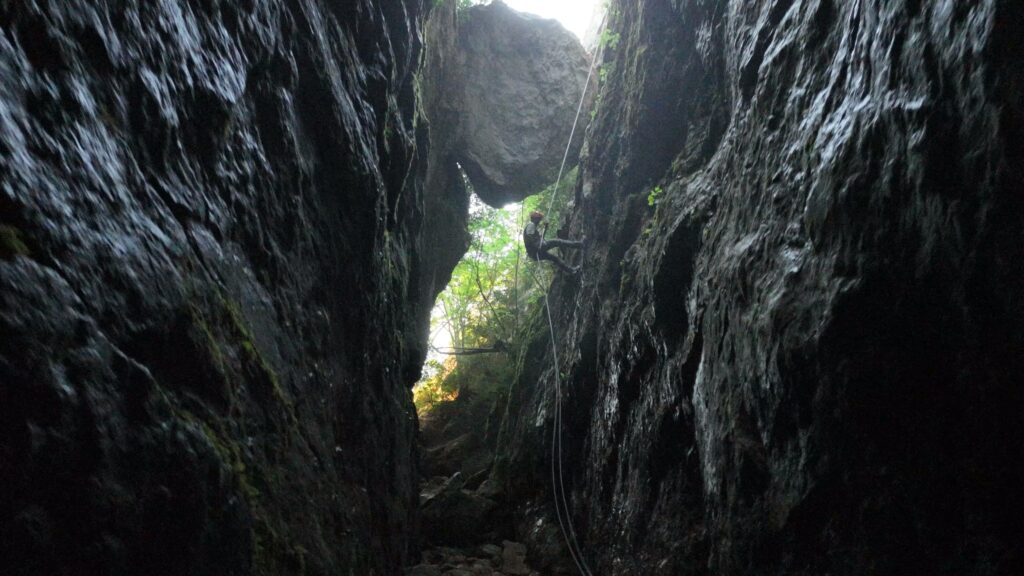
From there, our ground team takes over. Reaching that final stretch requires technical proficiency in mountaineering gear, single-rope techniques (SRT), rappelling, ascending, and negotiating hazardous ground under changing weather conditions. Where standard recovery vehicles or personnel without mountain training must stop, we initiate a foot approach to access and secure the aircraft directly on-site.
Through this specialized deployment, we provide a dedicated drone rescue service designed to retrieve assets in locations where conventional logistics are simply not feasible.
Asset Handling and On-Site Storage Extraction
Locating the aircraft is only the first half of the operation. The moment the drone is secured, a strict preservation protocol is executed on-site to prevent further damage.
- Perimeter and Asset Securing: Assessing the physical stability of the airframe to prevent secondary falls or electrical hazards from a damaged LiPo battery.
- Power Disconnection and Isolation: Removing any power sources to prevent short circuits from further degrading internal electronics or storage media.
- Memory Extraction and Environmental Isolation: Carefully removing memory media (MicroSD, SD cards, or integrated SSDs) and placing them in sealed, weather-proof enclosures to protect them from moisture, rain, dust, or debris.
Our priority at the crash site remains the precise location and recovery of crashed RPAS, ensuring the airframe and its data storage undergo minimal additional stress during extraction.
Digital Process: Drone SD Card Data Recovery
In many professional scenarios, the memory card is worth far more than the frame itself. A hard impact against rock or prolonged exposure to rain, extreme temperatures, or high humidity can corrupt the file system or damage the partition table.
Once the storage media is brought to our lab, we launch a specialized process to recover drone SD card data:
- Physical Inspection and Cleaning: Checking the exterior casing and contact pins. If the card shows signs of moisture or mud, it undergoes controlled drying and cleaning with dielectric solvents before any read attempt.
- Bit-by-Bit Imaging: To safeguard the original memory chip from destructive read cycles, we never work directly on the source card. We create a full forensic bit-stream image to perform all reconstruction processes safely.
- Data Reconstruction and File Repair: Using advanced raw data recovery tools and analyzing video/image file headers, we work to rebuild damaged sectors and extract native files (such as RAW photos, MOV, or MP4 containers).
Technical Note on Recoverability: Data recovery success depends heavily on the physical integrity of the internal NAND Flash chip. If the memory chip hasn’t suffered severe mechanical fracture or a total short circuit, the likelihood of recovering your files is high. While severe environmental exposure means 100% recovery can never be guaranteed in every case, we apply every technical measure available to retrieve the maximum amount of usable data.
Don’t Write Off Your Equipment or Your Data
An inflight failure doesn’t have to mean the total loss of your investment or a wasted field campaign. Whether your aircraft is stranded in a high-risk location or you need to extract critical files from a damaged memory card, GOAT Drones is equipped to evaluate the terrain and execute a tailored recovery plan.
Fill out the form below with the last known coordinates, aircraft model, and terrain conditions so our technical team can review the situation immediately.